GPU Marketplaces Are Cheapest, Until They Aren't
We analyzed the marketplace-style providers tracked by ComputePrices to find where marketplaces actually beat traditional GPU clouds, where they do not, and what the cheapest listing really buys.
- GPUs
- Cloud Computing
- GPU pricing

GPU Marketplaces Are Cheapest, Until They Aren't
GPU marketplaces dominate the cheapest RTX 4090 and RTX 5090 listings we track. Move up to B200s and the advantage mostly disappears.
We analyzed the marketplace-style providers tracked by ComputePrices to see where marketplaces actually beat traditional GPU clouds, and where the apparent savings come with tradeoffs in availability, reliability, and scale.
The short version: marketplaces are strongest where supply is fragmented. Thousands of independent hosts can undercut dedicated clouds on consumer GPUs. New data center accelerators are different. The providers that own large, uniform fleets often set the price floor themselves.
For live rates, use the GPU pricing table. We do not print dollar prices in articles because they can be stale within days.
Where marketplaces make the cheapest ten
The original analysis recorded the ten cheapest current on-demand and spot listings for six GPUs across providers on ComputePrices on 12 September 2026. Reserved commitments were excluded. Here, “marketplaces” includes the host marketplaces and aggregators described below; Runpod Community Cloud is included, while Secure Cloud is not.
These counts measure representation among low-price listings, not percentage savings, capacity, or market share. Mixing spot and on-demand also means the table is not a like-for-like comparison of uninterrupted service. The accompanying provider totals describe catalog coverage, not rentable stock.
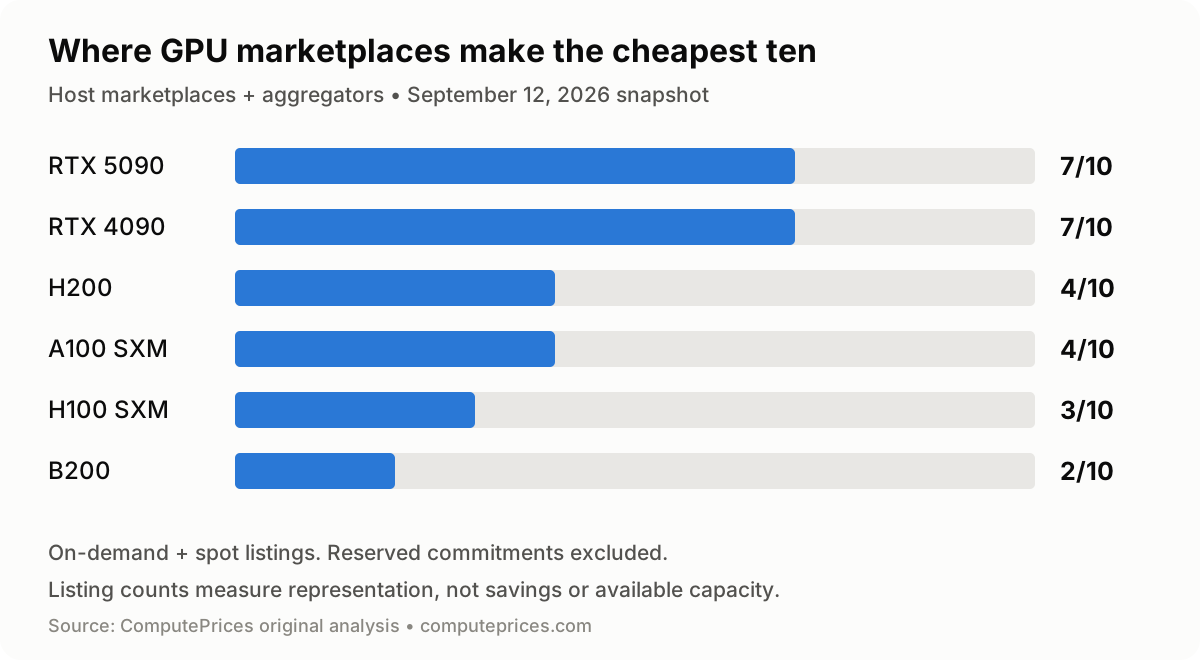 Marketplace-style providers occupy seven of the cheapest ten positions for RTX 5090 and RTX 4090, four for H200 and A100 SXM, three for H100 SXM, and two for B200.
| GPU | Marketplaces in cheapest ten | Share | Providers with a listing |
|---|---|---|---|
| RTX 5090 | 7/10 | 70% | 14 |
| RTX 4090 | 7/10 | 70% | 18 |
| H200 | 4/10 | 40% | 39 |
| A100 SXM | 4/10 | 40% | 37 |
| H100 SXM | 3/10 | 30% | 48 |
| B200 | 2/10 | 20% | 28 |
Marketplaces dominate the consumer-card results, but account for a minority of the cheapest data center listings. This is a comparison of six GPU models, not evidence that marketplace competitiveness declines with every increase in hardware price.
On consumer cards, marketplaces hold seven of the cheapest ten positions. Salad was the cheapest listing for both the 4090 and 5090 in this snapshot.
On data center cards, marketplaces hold only two to four positions. Those entries include interruptible capacity, aggregators reselling data center supply, and independent hosts. At the B200 tier, neoclouds that own the hardware set the floor. The only marketplace-style providers in the cheapest ten were an aggregator and a spot listing.
| GPU | Marketplace providers in the cheapest ten |
|---|---|
| RTX 5090 | Salad, Theta EdgeCloud, Lium, QuickPod, Vast.ai, Spheron, Runpod Community |
| RTX 4090 | Salad, QuickPod, Lium, Vast.ai, Runpod Community, GPU Outlet, Shadeform |
| H100 SXM | Compute Cheap (spot), Lium, GPU Outlet |
| H200 | Compute Cheap (spot), GPU Outlet, Spheron (spot), Lium |
| A100 SXM | GPU Outlet, Vast.ai, Runpod Community, Spheron (spot) |
| B200 | Spheron (spot), GPU Outlet |
Price floor is not scalable price. A cheapest listing is one machine in one place. It does not tell you what ten, 64, or 256 identical GPUs will cost, or whether they are available at all.
This suggests three useful GPU price concepts:
- Price floor: the cheapest currently observed listing.
- Available price: the cheapest capacity you can provision now for the required configuration.
- Scale price: the cheapest price available for a meaningful cluster of identical GPUs with the networking and reliability the workload needs.
The first is easy to compare. The other two require checking stock and obtaining a quote for the intended deployment; they are buying concepts, not additional measured fields in this analysis.
Why consumer GPUs are different
Consumer GPU supply is scattered across gaming PCs, workstations, mining infrastructure, and small hosting operators. A host marketplace can turn that fragmented hardware into rentable inventory without first financing a standardized fleet.
That model works especially well for fault-tolerant inference, rendering, and batch jobs. If a workload can move between unlike machines or restart after an interruption, cheap heterogeneous supply is an advantage.
The economics change for H100, H200, and Blackwell systems. Buyers often need multiple identical GPUs, high-speed interconnects, predictable storage, and a known security posture. Owning and operating a uniform fleet becomes an advantage. A single cheap marketplace node cannot substitute for a cluster.
Host marketplaces versus aggregators
"Marketplace" covers two different businesses.
Host marketplaces bring together capacity from independent operators. Hosts range from individuals with a gaming PC to small data centers with racks of accelerators. The platform handles discovery, provisioning, and billing, while the host sets or influences the price. Vast.ai, Runpod Community Cloud, Salad, QuickPod, io.net, Hyperbolic, Theta EdgeCloud, Lium, and Compute Cheap fit this model.
Aggregators and brokers resell capacity from established clouds and certified data centers. Buyers get one account, API, and bill across multiple suppliers. The aggregator sets the customer-facing price, which may differ from the underlying cloud's direct rate. Shadeform, Spheron, GPU Outlet, and Omega Gradient fit this model.
Host marketplaces expose individual machines and host-level differences. Aggregators simplify sourcing across suppliers. Neither model alone guarantees the lowest price, availability, or service quality.
Comparison at a glance
| Provider | Model | Best fit | Billing | Spot tier tracked | Stock signal | Current GPU breadth* |
|---|---|---|---|---|---|---|
| Vast.ai | Host marketplace | Automation and broad hardware search | Per second | Yes | Per offer | 52 |
| Runpod Community | Host marketplace | Interactive development | Per second | Yes | Per GPU count | 37 across both tiers |
| Salad | Container marketplace | Fault-tolerant inference and batch | Hourly | No | No | 37 |
| QuickPod | Host marketplace | Consumer GPU pods | Hourly | No | No | 12 |
| io.net | Decentralized network | Distributed clusters | Hourly | No | No | 17 |
| Hyperbolic | Marketplace + inference API | Data center GPUs and inference | Hourly | No | No | 3 |
| Theta EdgeCloud | Hybrid edge + cloud | Parallel edge workloads | Hourly | No | No | 6 |
| Lium | Host marketplace | Location-specific VM capacity | Hourly | Yes | No | 16 |
| Compute Cheap | Bid marketplace | Interruptible H100/H200 capacity | Hourly | Yes | No | 2 |
| Shadeform | Cloud aggregator | One API across many clouds | Hourly | No | Bookable offers | 17 |
| Spheron | Data center aggregator | Production and spot capacity | Per minute | Yes | No | 11 |
| GPU Outlet | Supply aggregator | Unusual GPUs and regions | Hourly | No | No | 70 |
| Omega Gradient | Aggregator + broker | Sourced reserved clusters | Hourly, prepaid | No | No | None current |
* Current GPU breadth is the number of distinct GPU models with a fresh price on ComputePrices on 12 September 2026. It measures publicly listed variety, not available capacity.
Six marketplace models worth understanding
Vast.ai: the deepest true marketplace
Vast.ai spans everything from a single RTX 3060 in a home to Secure Cloud partners with H100, H200, B200, and B300 nodes. Buyers can filter by GPU, VRAM, reliability, bandwidth, and location. On-demand, interruptible, and reserved pricing coexist, while the CLI, Python SDK, and API expose the same provisioning surface as the console.
That breadth creates variance. Two listings of the same GPU can have very different CPUs, disks, networks, and reliability. ComputePrices records verified hosts only, but Vast's platform certification should not be treated as certification of every machine.
Runpod: the marketplace discount in one product
Runpod puts its Community Cloud marketplace beside Secure Cloud in vetted data centers. Both use the same console, templates, and per-second billing, which makes the tradeoff unusually legible: community capacity is cheaper, while Secure Cloud offers more standardized infrastructure.
Runpod also reports stock per GPU count. Sold-out configurations can be marked as unavailable instead of silently disappearing, a stronger signal than most marketplace catalogs provide.
Salad: containers instead of machines
Salad turns community consumer GPUs into a managed container network. Buyers deploy images and replica counts rather than renting a VM or opening an SSH session. That makes it a strong fit for stateless inference and batch work, but a poor fit for jobs that need a persistent node.
Its catalog is unusually consumer-heavy and includes AMD cards. Prices are published through a fixed calculator rather than individual host asks, so the customer-facing rate is steadier even though the underlying supply remains distributed.
Lium: node pricing made visible
Lium publishes individual nodes with city-level locations, reliability ratings, and separate per-GPU and per-node hourly prices. Its catalog covers consumer cards through B200 and B300, with secure and spot tiers.
It also exposes a common pricing trap. A cheap per-GPU rate may require renting a 4x or 8x node. The relevant number is the minimum bill, not just the normalized GPU-hour rate.
Shadeform and Spheron: aggregation over ownership
Shadeform provides one API and bill across more than 30 clouds, with underlying suppliers and bookable offers visible in its directory. Spheron aggregates certified data centers with per-minute billing, spot capacity, and a sourcing process for larger clusters.
In both cases, compare the aggregator's price with the underlying cloud when both appear on ComputePrices. The convenience of one integration and broader sourcing can be worth a premium, but aggregation does not guarantee a lower rate.
GPU Outlet: breadth over standardization
GPU Outlet had the broadest catalog in this comparison: 70 distinct models across roughly 40 regions, from older consumer cards to current data center systems. It is useful when the requirement is a specific older GPU or country rather than the absolute newest accelerator.
ComputePrices collects its catalog API rather than the animated figures on its public pricing page, then collapses duplicate listings to the cheapest model-and-region combination.
Other marketplaces we track
- QuickPod focuses on Docker pods and consumer RTX cards, primarily in the US.
- io.net clusters distributed operators by region for Ray, container, and bare-metal deployments; payment workflows may involve the IO token.
- Hyperbolic combines a small high-end GPU catalog with an OpenAI-compatible inference API.
- Theta EdgeCloud routes work across community edge nodes and cloud capacity, with failover as a platform feature.
- Compute Cheap exposes a narrow catalog of spot capacity where owners bid for workloads.
- Omega Gradient combines a public marketplace with a brokered sourcing desk for reserved clusters.
How to read a marketplace price
Before treating a low number as comparable, ask what it is attached to.
- Per GPU or per node? A normalized rate can hide a 4x or 8x minimum rental. ComputePrices shows per-GPU rates, but the provider's checkout total is what matters.
- On-demand or interruptible? Vast interruptible bids, Runpod spot pods, Lium spot, Spheron spot, and Compute Cheap capacity can be reclaimed.
- Which tier? Community, secure, spot, standard, and dedicated tiers are different products. Compare them as such.
- Which machine? Check CPU, RAM, storage, bandwidth, location, and host reliability before assuming two GPUs are equivalent.
- Is it in stock? Some providers expose availability. Others publish catalog prices even when no capacity can be provisioned.
- Can it scale? Confirm the number of identical GPUs, topology, and cluster price before planning around the cheapest row.
- Who sets the price? An aggregator's rate is its own. It may sit above or below the underlying supplier's direct price.
Which model fits your workload?
Fault-tolerant inference and batch work: host marketplaces are strongest when jobs can restart, move between unlike machines, or scale across independent replicas. Salad's container model is built for this. Vast.ai and interruptible tiers can also work well.
Interactive development: Runpod Community Cloud, Vast.ai, Lium, and QuickPod provide machine- or pod-level access where SSH, templates, and a predictable individual node matter.
Production workloads: aggregators such as Shadeform and Spheron offer consolidated billing and easier multi-provider sourcing. Check the selected supplier's SLA, failover, support, and capacity guarantees; aggregation alone does not establish production readiness.
Large training clusters: dedicated GPU clouds are usually the better comparison set. Marketplace headline prices become less meaningful when the requirement is dozens or hundreds of identical GPUs with high-speed networking.
Unusual hardware or a specific country: GPU Outlet's catalog is the broadest of this group.
The cheapest listing remains useful, but it is the beginning of procurement, not the answer. Use the live GPU pricing table to compare current rates, then verify availability, minimum node size, and cluster requirements with the provider.