
Renting Blackwell GPUs: B200, GB200 and GB300 Compared
B200 comes on an 8-GPU HGX board; GB200 and GB300 come as slices of a 72-GPU NVL72 rack. Here is what that changes, how many providers list each card, and how to read their rows.
- GPUs
- NVIDIA
- Blackwell
- Pricing

Renting Blackwell GPUs: B200, GB200 and GB300 Compared
Renting Blackwell GPUs means choosing between two kinds of system before choosing a card. The B200 is sold on NVIDIA's HGX board, eight GPUs to a server, like the Hopper cards before it. The GB200 and GB300 are Grace Blackwell superchips, built into a liquid-cooled rack in which 72 GPUs share one NVLink domain. This guide covers what separates the three, how many providers list each one, and how to read their rows on the live pages. We print no rates here because they change daily; the GPU comparison table and each card's page show the current per-GPU figure and the date it was read.
For a spec and workload comparison that starts from the Hopper H200 and includes the HGX B300, see H200 vs B200 vs GB300: which NVIDIA GPU should you rent. This post stays on the Blackwell generation and on the question that post leaves open: what you are renting when a listing says GB200 or GB300.
B200 vs GB200 vs GB300: board or rack
Every Blackwell GPU in the cloud today sits in one of two systems:
- HGX B200 and HGX B300 are 8-GPU boards with SXM modules. NVIDIA lists 1.4 TB of GPU memory across the eight GPUs of an HGX B200 and 2.1 TB across an HGX B300, with 1.8 TB/s of NVLink bandwidth per GPU. The board goes into an ordinary server with x86 host CPUs. The catalog records these cards as form factor
with a scale-up domain of 8.SXM - GB200 NVL72 and GB300 NVL72 are racks. Each GB200 or GB300 superchip pairs one Grace CPU with two Blackwell GPUs, and 36 superchips make one rack of 72 GPUs. All 72 share one NVLink domain: NVIDIA lists 130 TB/s of NVLink bandwidth and 13.4 TB of GPU memory for the GB200 NVL72, and 20 TB for the GB300 NVL72. The catalog records these as form factor
with a scale-up domain of 72.Superchip
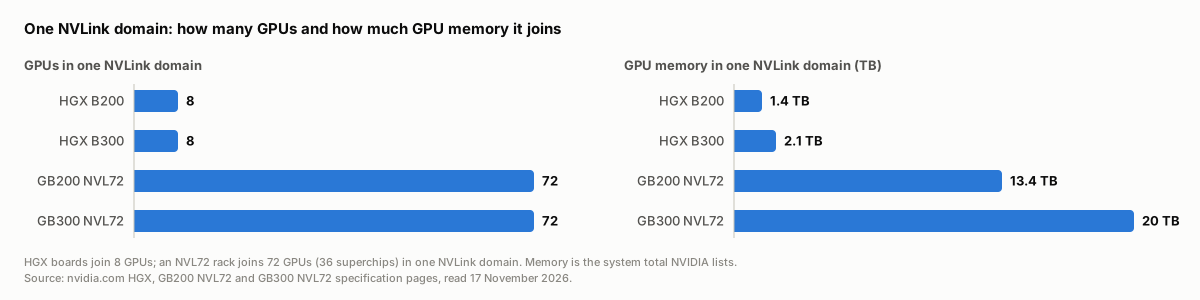 Two bar charts: HGX B200 and HGX B300 join 8 GPUs with 1.4 TB and 2.1 TB of GPU memory in one NVLink domain; GB200 NVL72 and GB300 NVL72 join 72 GPUs with 13.4 TB and 20 TB
Per GPU, the NVLink link speed is the same on a board and in a rack. What differs is how many GPUs sit on the far side of it. On an HGX board, a ninth GPU is on another server and is reached over the cluster network (InfiniBand or Ethernet). In an NVL72 rack, GPU 72 is reached over NVLink like GPU 2. That matters for work that splits one model across more than eight GPUs: tensor or expert parallelism across a large mixture-of-experts model, or serving a model too large for one node's memory. For a model that fits on one 8-GPU board, the rack's extra reach does nothing.
Two more differences come with the rack:
- The host CPU is Grace, which is Arm. Containers and binaries need
builds. Most mainstream frameworks publish them, but a stack with x86-only dependencies needs checking before you rent.arm64 - The rack is liquid-cooled and built as one unit. Providers buy and deploy it whole, which is one reason fewer of them offer it than offer HGX servers.
Which Blackwell card to rent for which job
- B200: the default Blackwell rental. Fine-tuning, training on clusters of 8-GPU nodes, and inference for models that fit on one board. It is listed widely, so you can compare many sellers and regions.
- HGX B300: the same 8-GPU form with Blackwell Ultra GPUs and more memory per board. A fit for inference where memory per GPU decides how many GPUs a model needs. Its page is HGX B300.
- GB200: rack-scale NVLink for models or parallelism schemes that outgrow eight GPUs, on the first Grace Blackwell generation.
- GB300: the same rack with Blackwell Ultra GPUs and more memory per rack. As of November 2026 it is NVIDIA's top-tier data center system, and the hardest of the four to find at a public rate.
If your work fits on one 8-GPU node, the choice is between B200 and HGX B300, and the H200 is still worth comparing. The rack cards earn their place only when the job spans more GPUs than one board holds.
Where you can rent B200, GB200 and GB300
The number of sellers falls sharply from board to rack:
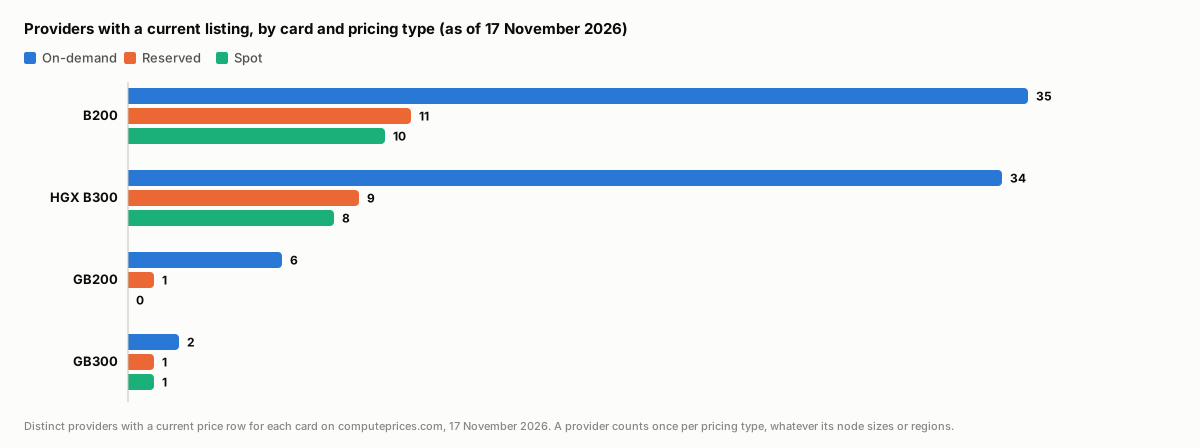 Grouped bar chart of providers with a current listing as of 17 November 2026: B200 35 on-demand, 11 reserved, 10 spot; HGX B300 34, 9 and 8; GB200 6, 1 and 0; GB300 2, 1 and 1
As of 17 November 2026:
- B200 has current on-demand rows from 35 providers, from hyperscalers and GPU-focused clouds to marketplaces, plus reserved and spot rows from about ten each.
- GB200 has on-demand rows from six: CoreWeave, Oracle Cloud, GMI Cloud, fal.ai, and the marketplaces Vast.ai and Omega Gradient. One more provider lists a whole rack as a reserved pre-order.
- GB300 has on-demand rows from two, Oracle Cloud and Verda, and Verda also lists spot. The same reserved pre-order listing covers a GB300 rack.
These counts are what providers publish. Much rack-scale capacity is sold under contracts that never reach a pricing page, so a short list on the site means few public rates, not that no one runs the hardware. The counts move: the provider total on each card page is live.
What a GB200 or GB300 listing rents
Nobody rents a single superchip in isolation. A rack is built from 18 compute trays, each holding two superchips (two Grace CPUs and four GPUs), plus nine NVLink switch trays that join every tray. A listing rents some part of that:
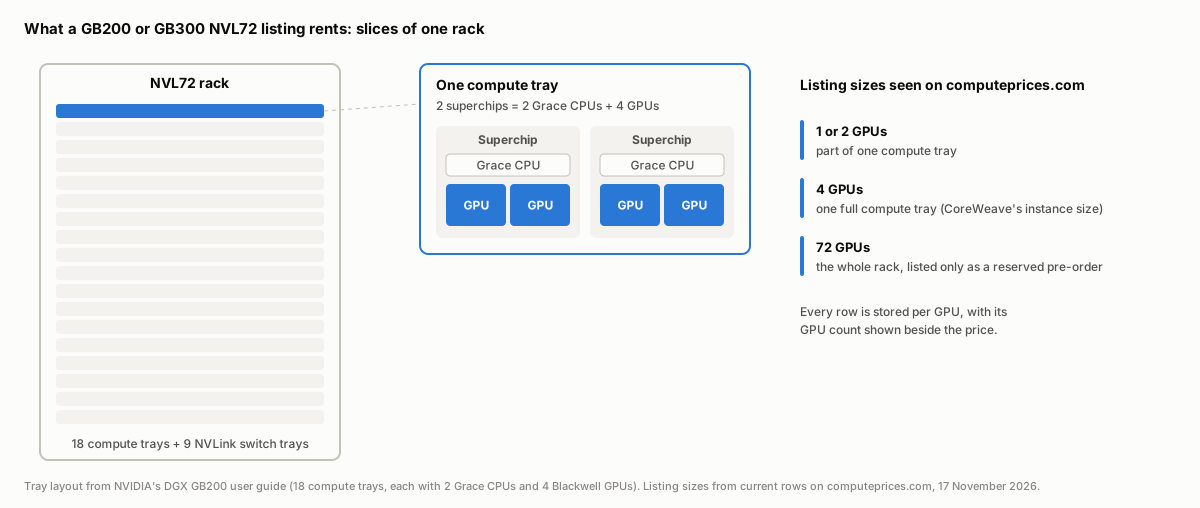 Diagram: an NVL72 rack holds 18 compute trays and 9 NVLink switch trays; each compute tray holds two superchips, which is two Grace CPUs and four GPUs; listings rent 1 or 2 GPUs of a tray, one full 4-GPU tray, or the whole 72-GPU rack
- 4 GPUs is one compute tray. CoreWeave sells GB200 NVL72 and GB300 NVL72 in instances of four GPUs, each instance two superchips, and the site stores those rows with a GPU count of 4.
- 1 or 2 GPUs is part of a tray. Several of the GB200 rows on the site are this size.
- 72 GPUs is the whole rack, which on the site appears only as a reserved pre-order.
A small slice of a rack gives you the hardware but not the reason to rent it: four GPUs talk to each other over NVLink on an HGX board too. Ask the provider whether a multi-tray order lands in the same NVLink domain, because that is what the rack offers and a board does not.
How to read the live Blackwell listings
Every rate is per GPU per hour. A provider that prints an instance total, such as a price for a 4-GPU tray or an 8-GPU node, has it divided by the GPU count before it is stored, and the row keeps the GPU count. The methodology page records how each figure was converted.
The VRAM figure on a superchip card describes the whole superchip. The GB200 and GB300 card pages state the memory of one superchip, which holds two GPUs, while each price row is for one GPU: 372 GB per GB200 superchip is 186 GB per GPU, and 558 GB per GB300 superchip is 279 GB per GPU. Those are NVIDIA's rack totals (13.4 TB and 20 TB) divided across 72 GPUs, and the same per-GPU figures CoreWeave lists.
Node size, pricing type and region are separate rows. A provider's 1-GPU and 8-GPU B200 offerings, its on-demand and reserved rates, and its rates in two regions are each a row of their own, because providers price them differently. Compare like with like: the GPU table filters by pricing type, and each row shows its GPU count and region.
Reserved means a term. A reserved row carries its commitment length in months. Compare reserved rates only against rates for the same term, and against on-demand only once you know how much of the term you will use.
Stock is shown where the provider reports it. Some sources say whether an offering can be rented right now, and the site marks those that report it as sold out. Many catalogs, including most hyperscalers, publish no stock signal, so an unmarked row is a listed rate, not a promise of capacity. For the rack cards, where public capacity is thin, contact the provider before planning around a listing.
Marketplace rows are one seller's offer. On a marketplace such as Vast.ai, the stored rate is the cheapest current listing from one host, never an average. See GPU marketplaces compared for how marketplaces differ from clouds that run their own hardware.
If you pull rows from the API, each GPU price row carries the model's
form_factorscale_up_domainFrequently asked questions
What is the difference between the B200 and the GB200? They use the same generation of Blackwell GPU in different systems. A B200 sits on an 8-GPU HGX board in an x86 server. A GB200 superchip pairs two Blackwell GPUs with an Arm-based Grace CPU, and 36 of them form a GB200 NVL72 rack in which all 72 GPUs share one NVLink domain.
Is the GB300 the same as the HGX B300? They use the same Blackwell Ultra GPU. HGX B300 is the 8-GPU board, sold like a B200 server. GB300 is the superchip that pairs two of those GPUs with a Grace CPU, built into the 72-GPU GB300 NVL72 rack. The site lists them as separate cards: HGX B300 and GB300.
Where can I rent a GB300? As of 17 November 2026, two providers publish on-demand GB300 rates on the site: Oracle Cloud and Verda, which also lists spot. The GB300 page shows the current list and each provider's per-GPU rate.
How much does it cost to rent a B200, GB200 or GB300? Rates change daily and differ several-fold between providers for the same card, so we do not print them in posts. The B200, GB200 and GB300 pages show every current per-GPU rate with its provider, GPU count, pricing type and date.
Do I need a full NVL72 rack? Only when a job needs more than eight GPUs joined by NVLink, such as a model split across more GPUs than one board holds. For anything that fits on one 8-GPU node, an HGX B200 or HGX B300 server does the same work, and many more providers list it.
The weekly price report. One email every Monday with the week's notable GPU and LLM API price moves. No spam.